
How a utility attacked a multimillion-dollar idling-fine problem from two sides
Idling penalties topped $5 million in a year and were climbing fast. Agile Brains engineers helped build a daily analytics dashboard to prevent idling and a generative AI solution to contest the summonses the utility shouldn't be paying.

A large East Coast electric and gas utility was paying millions of dollars a year in vehicle-idling penalties, and the bill was climbing fast. Working alongside a leading consultancy, Agile Brains engineers helped the utility fight back on two fronts: prevent the idling, and contest the summonses it shouldn't be paying.
The challenge
The utility runs a large fleet in a city with strict anti-idling rules. Idling is capped at a few minutes, with tighter limits near schools and parks, and residents can film idling vehicles and submit the video for penalties. The result was a fast-growing bill: more than $5 million in penalties in a single year, a 213% jump in fees year over year, on more than 9,000 summonses.
Two problems compounded it. On prevention, the utility had only a stale monthly dashboard built by hand in Excel, with no way to see idling trends or target the worst offenders before violations happened, and every refresh erased the history. On disputes, summonses arrived by paper mail months after the fact and were typed into spreadsheets one by one. With no practical way to review the evidence at scale, the utility paid almost every ticket, including ones it could have contested.
How we helped
Agile Brains partnered with a leading consultancy, with our engineers embedded across both workstreams and doing much of the hands-on build. The program attacks the problem from two directions.
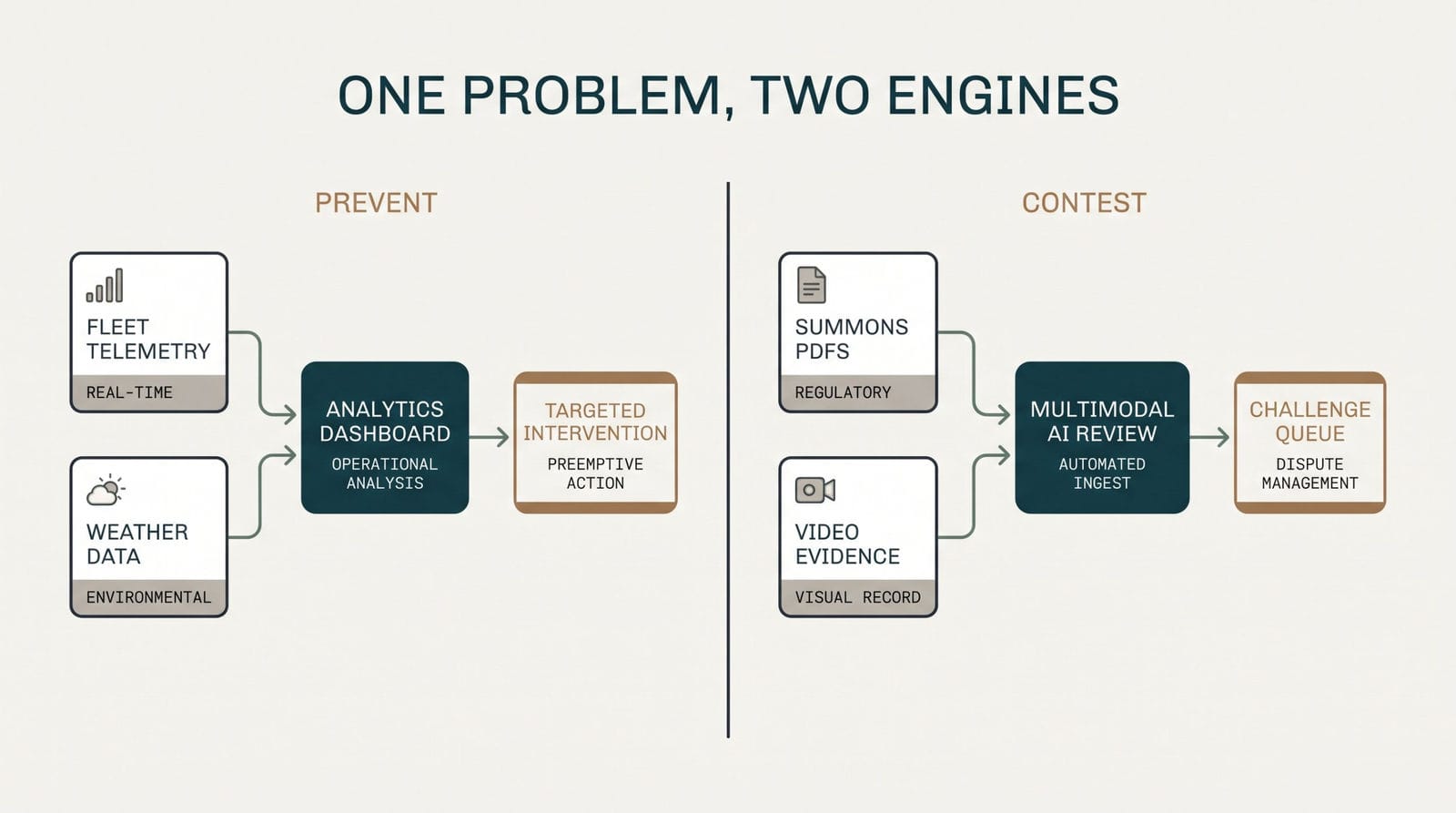
Prevent: an analytics dashboard (delivered). A self-service dashboard consolidates fleet telematics and weather data and refreshes automatically every day, replacing the manual monthly report. Leadership, department managers and supervisors can filter by organization, section and individual vehicle; set a configurable idle threshold to find the worst idlers; see trends by day, time and season; check how idling tracks with temperature; view an interactive location map; and export to CSV. Historical data is now preserved, so trends can be analyzed over time.
Contest: a generative AI summons review (MVP in development). An automated pipeline ingests summons data, including the PDFs and the citizen-submitted video evidence. A multimodal large language model and an agentic review workflow assess each summons for valid grounds to challenge, then surface cases to the Legal and Environmental Health & Safety team through a web app that prioritizes, assigns and tracks them. A person reviews every decision. Reporting covers summons trends, repeat offenders, amounts paid, and how the model's assessments compare with court outcomes, so the value can be measured. The solution runs on cloud storage, a data warehouse and an application database, with batch processing to keep inference costs down.
The result
The utility has moved from paying nearly every ticket to targeted action on both fronts. The dashboard replaced a hand-built monthly report with a daily, self-service view, so supervisors can go straight to the worst idlers, and trends are no longer lost on each refresh. The summons review gives Legal and EH&S a way to examine evidence and challenge invalid summonses systematically instead of paying by default. Modest savings have already been realized in the early phase, and less idling means lower emissions as well as lower fines.
The dashboard is delivered. The generative AI solution is an MVP in development, so its savings are projected, not yet realized at scale.
By the numbers
- More than $5 million in idling penalties in a single year before the program
- 213% year-over-year jump in idling fees
- More than 9,000 summonses received in one year
- Roughly $1.4 million to $3.2 million in projected annual savings once the generative AI solution reaches production
- Daily automated refresh, replacing a manual monthly report